A practical capability, not an isolated tool.
A responsive educational website combining audience guidance, teaching methodology, original work, class formats, FAQs, and trial booking.
A bilingual learning and conversion platform for live online drawing classes, guiding children, teenagers, and adults from uncertainty to a free trial lesson.
View live website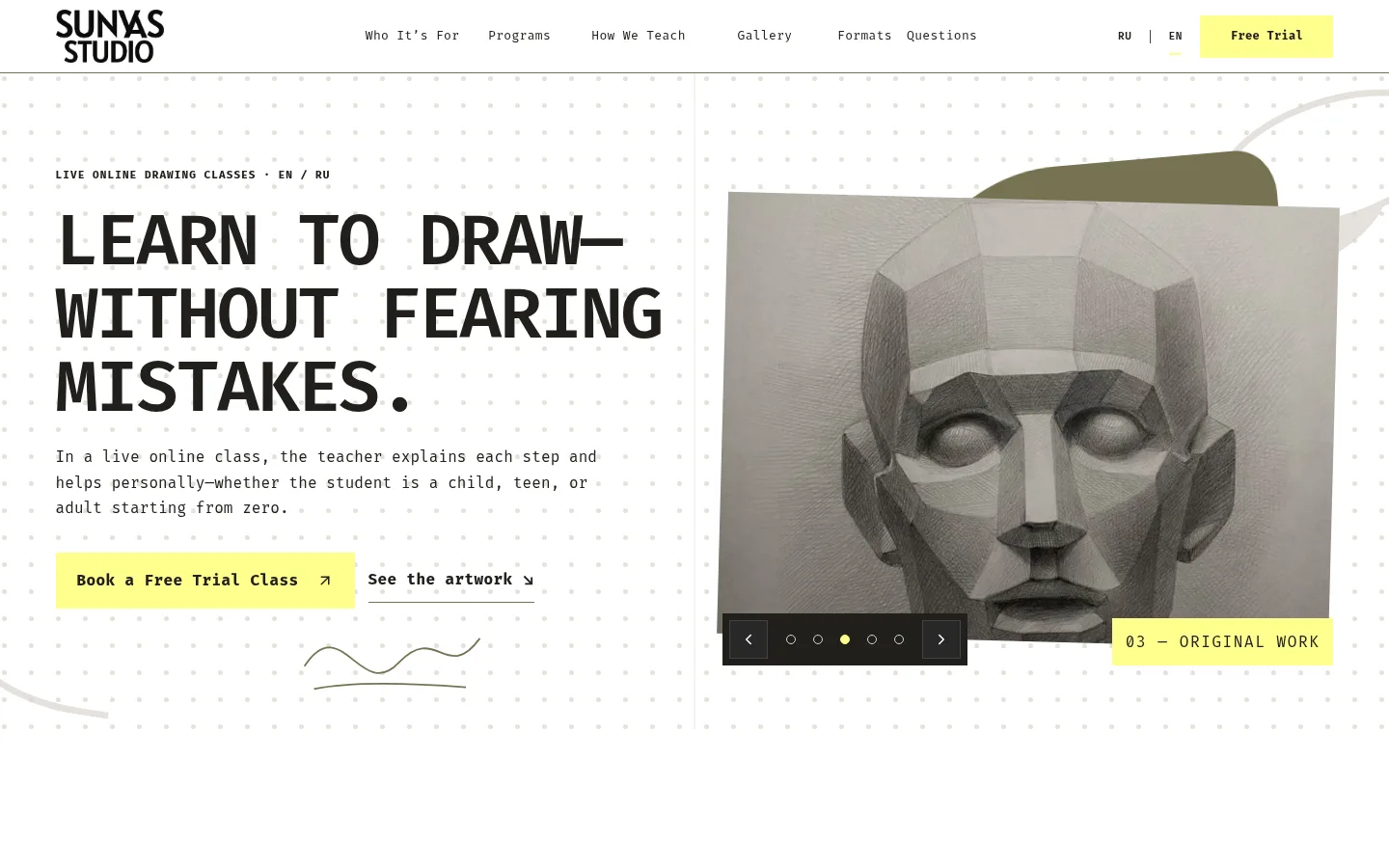
Our perspective
A responsive educational website combining audience guidance, teaching methodology, original work, class formats, FAQs, and trial booking.
Clear explanations reduce anxiety for beginners and parents while allowing visitors to choose a suitable learning format with realistic expectations.
Independent teachers, creative schools, and education businesses serving several age groups, experience levels, or languages.
Purpose and decisions
A closer look at the audience problem, the reason behind the chosen experience, and how each part helps a visitor move from uncertainty to a useful next action.
They are evaluating whether the teacher will be patient, whether online learning can work, whether the student needs previous experience, and whether a class will build confidence rather than create more pressure. A gallery alone cannot answer those questions. The website must make the teaching relationship understandable before asking someone to provide contact details or commit to a recurring format.
For a child, the value may be turning curiosity into foundations through achievable projects. A teenager may need perspective and composition that transform scattered drawing habits into a system. An adult starting from zero often needs permission to learn without jargon, comparison, or perfection. Segmenting these situations helps visitors recognize themselves without creating separate disconnected brands or websites.
Original work demonstrates capability, but the method explains how that capability will help the student. The site describes a progression from observation and main forms through composition and detail, along with live demonstration and personal feedback. Explaining that mistakes reveal the next learning step establishes a calmer philosophy and differentiates guided education from copying a prerecorded tutorial.
Class length, available languages, basic supplies, format differences, rescheduling, and response expectations are addressed before the final action. The trial then becomes a genuine fit check: the student experiences how the teacher explains and receives a recommendation afterward. This is more credible than forcing an early package decision and gives both sides evidence before choosing mini-group or one-to-one learning.
Children, teens, and adults are addressed through distinct goals and concerns, from keeping curiosity alive to building perspective, composition, light, and confident independent practice.
Audience segmentation · Information architecture · Education UXThe site explains the progression from observation and simple forms to composition and detail, positioning mistakes as useful feedback rather than failure.
Method communication · Trust · Content strategyA free 45–60 minute class, transparent format comparison, practical FAQs, bilingual EN/RU delivery, and a clear response expectation reduce uncertainty before booking.
Lead generation · Bilingual UX · Conversion designHow we create value
We treat sunvas studio as part of a wider operating system. The work is shaped by the business outcome, the people who depend on it, and the responsibilities that remain after launch.
We first establish what is happening today, who is affected, and which result would make the investment worthwhile. For sunvas studio, that means separating the underlying operational problem from a requested feature or platform. Constraints around time, risk, existing systems, skills, compliance, and budget are made visible early. This gives the team a shared definition of success and prevents technically impressive work that does not change the client’s actual situation.
Audience-led program structure cannot be evaluated in isolation. We map users, information, integrations, permissions, failure paths, and ownership across the complete workflow. Decisions are documented so stakeholders understand why a boundary exists and what trade-off it protects. This is especially important when teaching method made visible depends on external platforms or business teams. Clear architecture reduces hidden coordination costs and makes later change safer rather than progressively more fragile.
Delivery is organized into reviewable increments that demonstrate real behaviour, not just completed tasks. We verify usability, security, data quality, performance, accessibility, and operational readiness in proportion to the risk of the system. Where low-risk trial conversion is involved, representative scenarios include failure and recovery as well as the successful path. Stakeholders can inspect progress, challenge assumptions, and adjust priorities before uncertainty becomes embedded in a large release.
Launch is a transition into operation, not the end of the engagement. Monitoring, support boundaries, documentation, backups, security updates, incident response, and improvement priorities are agreed before the system becomes business-critical. We connect technical signals to customer and operational impact so teams know what needs attention and why. The result is sunvas studio that can be understood, supported, and evolved without depending indefinitely on undocumented knowledge or individual heroics.
Next step
Tell us what the audience needs to understand, do, or trust. We will define the smallest complete digital experience around that outcome.
Discuss your situation